Travis commissioners considering commuter shuttle for downtown workers: "By Suzannah Gonzales Travis County commissioners are expected to vote today ... use 10-passenger vans or buses running as far as Hays and Bastrop counties, ...
"
Tuesday, January 12, 2010


Friday, January 8, 2010
Bexar and Collin DA's races: Who gets to wear the bandoliers?
Bexar and Collin DA's races: Who gets to wear the bandoliers?: "Having recently rounded up some of the more interesting criminal-justice related and appellate judicial elections in the offing in 2010, I should add two District Attorneys' races to the list that I failed to mention:
Bexar County DA: Dems' time?
A couple of different folks have now told me to watch Democrat Nico Lahood out of Bexar County as a strong challenger to incumbent Republican DA Susan Reed. Offhand, his bio looks solid, and from a campaigning perspective, the fact that he sits on a major hospital board and is active with St. Mary's alumni and the local criminal defense bar perhaps indicates he can raise TV money. He'll need it. Susan Reed will be a tough opponent and that would be a big Democratic get in a year when the county party is in disarray. In 2006 Reed won with 60+% of the vote, but she's also taken a few hits since then and the countywide vote tipped consistently Democrat in 2008.
Collin County DA: Who gets to wear the bandolier?
Meanwhile, at Frisco DWI Lawyer we find the most detailed account I've seen of the candidate field for Collin County District Attorney, which is open this year after John Roach decided to call it quits. The GOP primary race looks to be a highly competitive contest: Greg Willis, a Perry appointed judge who resigned to run for DA; Jeff Bray, the senior legal advisor to the Plano Police Department; James Angelino, who is a former ADA from Denton County; and criminal defense lawyer and former Dallas ADA John Reed. Democrats have a pretty qualified challenger lined up in Rafael de la Garza, a former Dallas ADA and Western District Assistant US Attorney, but his candidacy on paper is a longshot; he'd need resources, luck, and maybe help from an inept opponent to win.
Question One to all these Collin County candidates: Do you support incumbent John Roach's efforts to outfit and deploy a DA Office SWAT-like tactical team using asset forfeiture money? Question Two: Will you rescind his decision? Really. That's not a joke or misprint. The outgoing DA is putting together his own tactical team equipped for forced entry for which he recently sought to purchase:
The Collin County Observer helpfully provides a link to the relevant agenda item and backup documentation. "
"
Bexar County DA: Dems' time?
A couple of different folks have now told me to watch Democrat Nico Lahood out of Bexar County as a strong challenger to incumbent Republican DA Susan Reed. Offhand, his bio looks solid, and from a campaigning perspective, the fact that he sits on a major hospital board and is active with St. Mary's alumni and the local criminal defense bar perhaps indicates he can raise TV money. He'll need it. Susan Reed will be a tough opponent and that would be a big Democratic get in a year when the county party is in disarray. In 2006 Reed won with 60+% of the vote, but she's also taken a few hits since then and the countywide vote tipped consistently Democrat in 2008.
Collin County DA: Who gets to wear the bandolier?
Meanwhile, at Frisco DWI Lawyer we find the most detailed account I've seen of the candidate field for Collin County District Attorney, which is open this year after John Roach decided to call it quits. The GOP primary race looks to be a highly competitive contest: Greg Willis, a Perry appointed judge who resigned to run for DA; Jeff Bray, the senior legal advisor to the Plano Police Department; James Angelino, who is a former ADA from Denton County; and criminal defense lawyer and former Dallas ADA John Reed. Democrats have a pretty qualified challenger lined up in Rafael de la Garza, a former Dallas ADA and Western District Assistant US Attorney, but his candidacy on paper is a longshot; he'd need resources, luck, and maybe help from an inept opponent to win.
Question One to all these Collin County candidates: Do you support incumbent John Roach's efforts to outfit and deploy a DA Office SWAT-like tactical team using asset forfeiture money? Question Two: Will you rescind his decision? Really. That's not a joke or misprint. The outgoing DA is putting together his own tactical team equipped for forced entry for which he recently sought to purchase:
2 DPMS 'AP4' 5.56 caliber Panther CarbinesThose are gonna be the best-armed prosecutors I've ever heard of, but it could be the source of intra-office jealousy: Which prosecutors do and don't get helmets? And who gets to wear the bandoliers? I wonder if, for liability purposes, using a ram, bolt-cutter or 'hooligan tool' would qualify the DA's office for 'absolute immunity'?
2 Remington Model 870 12 gauge shotguns with 7 round magazines, pistol grips and folding stocks.
2 LED lights for the shotguns
2 Tactical Ballistic shields
10 Ballistic helmets
2 shoulder ammo bandoleers (a la Pancho Villa?)
2 Blackhawk Tactical backpack kits, includes a heavy duty ram, a bolt cutter and a hooligan tool (for breaking down doors).
6,000 rounds of 5.56 caliber NATO ammunition.
etc....
The Collin County Observer helpfully provides a link to the relevant agenda item and backup documentation.
Thursday, January 7, 2010
Canadian Researcher “Crime is genetic”
Canadian Researcher “Crime is genetic”: "
Crime
Criminals might be “born to be bad,” genetically and inextricably pre-programmed at birth to engage in violent and other criminal behaviour, accumulating evidence suggests.
The concept of a “crime gene,” and the explanation “my genes made me do it,” are gaining in acceptance among many researchers. This development is generating novel challenges in criminal prosecutions.
In 1907, Sir Francis Galton first put forward the theory of “inheritance of criminal tendancies.” Since then, sophisticated studies have increasingly confirmed a genetic basis for some criminal actions.
“Genetics and molecular biology have provided some significant insights into behaviour associated with inherited disorders,” confirmed Joseph McInerney of the Foundation for Genetic Education and Counseling.
Recently, the Italian judiciary reduced the sentence of a convicted murderer on the grounds that his genes predisposed him to commit homicide.
“The odds of becoming a criminal are not equal at birth,” suggested Irving Gottesman of the University of Virginia.
Preliminary information indicates that most criminal behaviour could be inescapably inherited.
“Individuals with these genes could find themselves engaging in criminal activity,” suggested Caitlin Jones at Rochester Institute of Technology. “There is a genetic component to criminal behaviour.”
Increasingly, defence attorneys are requesting that judges admit evidence suggesting clients are genetically predisposed towards violent or other criminal actions — the so-called “DNA defence.”
At issue is a body of research linking criminal behaviour to certain inherited genes. A 2008 study at Hebrew University in Israel identified argenine vasopresser receptor-1 (AVPR1 gene) as a cause for “ruthless” behaviour. Research in 2009 by Rose McDermott at Brown University uncovered a “warrior gene” responsible for high levels of aggression in response to provocation.
In 1995, a Dutch study showed that males in a family whose members repeatedly engaged in crime had a mutated monoamine oxidase-A (MAOA) gene. Recently, Kevin Beaver’s research confirmed that boys with mutated MAOA genes are more likely to join gangs.
Last year, Guang Guo and colleagues showed the same MAOA variant generates violent delinquency. Research at the Civic Research Institute suggests MAOA is a “disinhibiting” gene, and mutations make people more likely to commit crimes.
According to Debrah Denno at Fordham Law School, “many people who commit homicides also have… relatives who are incarcerated.”
She explained that “genetic mitigation” can show that an offender might not be responsible for his actions.
Sarnoff Mednick at the University of California confirms that adopted children whose biological parents are criminals are much more likely to become criminals themselves, even if their adopted parents are law-abiding.
If criminals are genetically pre-programmed to commit crimes, then the assumption that incarceration might reshape criminal behaviour could be flawed. According to a 2003 ruling of the New York Supreme Court, genetic predispostion evidence raises the ugly matter of “future dangerousness.”
Of critical significance, as pointed out by philosopher Don Brock, is the conundrum that if an individual’s genes are a principle cause of behaviour, and if those genes are unalterable, and their effects unchangeable, is it justifiable to be held responsible for the resultant actions?
Robert Alison has a PhD in zoology and is based in Victoria, B.C.
Email this to a friend?
Send this page to Print Friendly
Digg this!
Share this on Facebook
Share this on del.icio.us
Tweet This!
Post this to MySpace
Share this on Wikio
Share this on Reddit
Stumble upon something good? Share it on StumbleUpon
Buzz up!
Add this to Google Bookmarks
Share this on Linkedin
Share this on FriendFeed
Sphinn this on Sphinn
Share this on Technorati
Share this on Mixx
Subscribe to the comments for this post?
Related posts:
"NEW - Perry rips proposed new smog limits
NEW - Perry rips proposed new smog limits: "Gov. Rick Perry is ripping the proposed new stricter federal health standards for smog, saying they would kill jobs without improving human health."
Wednesday, January 6, 2010
Police say man called 911 to report he murdered his mother
Police say man called 911 to report he murdered his mother: "SAN ANTONIO (AP) - Police say a 57-year-old San Antonio man who is accused of killing his mother called 911 to report the slaying.
Ralph Wayne Nunley remained in the Bexar County Detention Center on Wednesday on a murder charge. A jailer, who..."
Ralph Wayne Nunley remained in the Bexar County Detention Center on Wednesday on a murder charge. A jailer, who..."
Tuesday, January 5, 2010
Sheriff accused in murder scheme urged to resign
Sheriff accused in murder scheme urged to resign: "


"
Federal charges that the longtime sheriff of Gallatin County in southern Illinois sold marijuana while in uniform seemed odd enough to county board chairman Randy Drone. But new allegations the sheriff plotted from jail to have someone killed made the case even stranger.
CIA agents a 'menace to themselves'
CIA agents a 'menace to themselves': "
• Attacks expose long-term US intelligence failings
• Obama launches inquiry into Christmas jet bomb
Long-term weaknesses in US intelligence-gathering have been ruthlessly exposed over the last fortnight by the Christmas Day airline plot and the Afghanistan suicide bombing that killed seven CIA officers, according to former and serving intelligence officers.
They are scathing about the way the operation in Afghanistan has been run and say it is part of an institutional weakness on the part of the CIA and other intelligence-gathering agencies.
The biggest crisis in intelligence-gathering since 9/11 has been brought about mainly because no single agency is in charge, they say, creating a situation in which about a dozen US intelligence agencies fight for their own turf.
The former officers were speaking as Barack Obama held an inquest at the White House into the communication breakdown between the CIA and other agencies that allowed the Nigerian bomb suspect Umar Farouk Abdulmutallab to come close to blowing up a US passenger plane on Christmas Day.
A report published on the eve of that meeting by the deputy head of military intelligence, Maj Gen Michael Flynn, offered a damning assessment of intelligence-gathering in Afghanistan. He said the vast apparatus there was only marginally relevant. Analysts in Washington were so starved of information, that 'many say their jobs feel more like fortune-telling than detective work'.
Larry Johnson, a former CIA officer and counterterrorism agent, said the CIA had become 'sloppy' in its field intelligence gathering, and the suicide bombing at Khost in Afghanistan was part of that.
The CIA thought they had turned Humam Khalil Abu Mulal al-Balawi, a Jordanian doctor, into one of their agents and it allowed him on to the base after he asked for a meeting, promising to provide information about al-Qaida. He then blew himself up.
A school friend, Mohammed Yousef, said Balawi had deceived family and friends, telling them in March he was going to Turkey for further medical studies when he in fact travelled to Afghanistan to join the militants. He had wanted to die in a holy war, and wrote angry articles on the web calling for jihad against the US and Israel.
Johnson pointed to tactical failures at Forward Operating Base Chapman in Afghanistan, where the attack was made. He said an intelligence source as significant as Balawi should never have been brought inside the base, because it risked exposing him. Balawi should also have been debriefed by a much smaller group than the dozen or so CIA employees present when he set off the bomb.
He described those errors as symptomatic of a larger trend within the agency of putting desk workers into the field. 'You have a lot of inexperienced people being shoved out into the field without adequate mentoring and without proper training,' Johnson said.
The CIA has suffered one crisis after another since its inception in the middle of the last century. One of its high points was its claim to have contributed to winning the cold war, but a low point was reached with the failure to prevent 9/11. Last year the Obama administration revealed details of waterboarding and other torture, and there were newspaper reports about links between the CIA and the private contractor Blackwater.
Pat Lang, a veteran of military intelligence, who was head of the analysis and clandestine human intelligence for the Defence Intelligence Agency, echoed Johnson's criticism of the Khost operation.
'A number of basic rules were violated. One that comes to mind is you never trust foreign agent assets,' he said.
'I think it is a very big crisis. It shows that the level of skill in operations has declined so far that they are a menace to themselves,' said Lang.
According to Lang, one of the major flaws in intelligence gathering was the failure of the Bush administration after 9/11 to put one agency in overall charge.
Gary Berntsen, a former senior CIA officer who served in the Middle East, said a hiring freeze under President Clinton had left the CIA with a lack of experienced senior intelligence gatherers.
'When a bunch of guys like me retired all at 50, there's a gap. And now we've got a lot of inexperienced people coming on who are being forced into senior positions in the field before they're ready.'
But he disputed suggestions that the bombing at the base in Khost indicated systemic problems within the agency. 'The agency deals with these sorts of things every single day successfully, and this is an individual case where they failed. They got beat on this case, they got beat bad ... My heart goes out to the families, but this does not indicate that the agency is in crisis in any way.'
He also criticised Obama's selection of Leon Panetta to head the CIA, noting his lack of intelligence experience. 'I'm sure he's learning every day, but you don't need to be learning on the job. For anyone to say it doesn't have an effect is dishonest.'
guardian.co.uk © Guardian News & Media Limited 2010 | Use of this content is subject to our Terms & Conditions | More Feeds
"
Monday, January 4, 2010
How a Boy Becomes a Martyr: The Dangers of Web 2.0 Technology
How a Boy Becomes a Martyr: The Dangers of Web 2.0 Technology: "
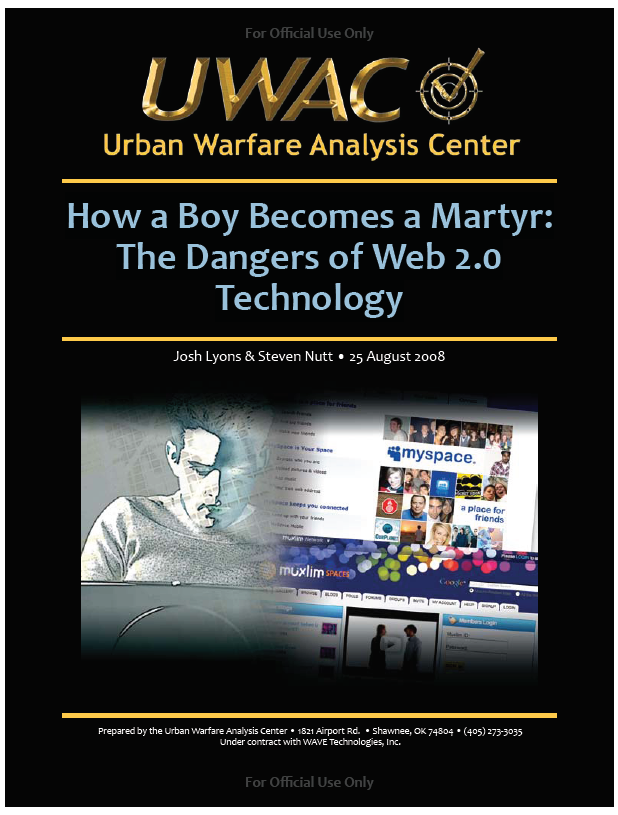 Urban Warfare Analysis Center
- 6 pages
- For Official Use Only
- August 8, 2008

"Scope Note
The following report is a fictitious account of how a young person in America could become a suicide bomber for an Islamic extremist group. It is the fifth in a series of reports on Web 2.0 technology and future urban warfare. All references to people, groups, and products are intended for illustrative purposes only. As such, the authors do not suggest that any of the products or organizations listed condone or support extremist activities.
Pete is a 16-year-old boy in Detroit who is moody and depressed. He lacks a stable home life, is
socially awkward at school, and has no clear direction in life. Like many teens around the world,
he finds solace in friendships made online through social networking sites.Pete has created a homepage on MySpace. Part of his story of angst is laid out on his
personal profile, along with his location and contact information. A young man in Lebanon
named Jafar sees Pete’s profile and sends out a “friend request,” which Pete accepts. Now that
Pete and Jafar are identified as friends on MySpace, they can view each other’s private pages.
Jafar learns about the details of Pete’s anger and frustration. Pete, in turn, reads about Jafar
and becomes “linked up” with Jafar’s network of friends. This is Pete’s first introduction to the
world of Islam.Now armed with an arsenal of contacts from across the Middle East, Pete becomes enlightened
by Islam. He reads voraciously about a father figure in the Prophet Muhammad that he
desperately craves. He is encouraged by his many new friends, although most of those “friends”
are simply Jafar using multiple MySpace pages. Pete learns that converting to Islam is easy
and that he can advance to a higher “stage” in the online community by doing so. He eagerly
converts.Pete is then directed by his MySpace friends, many of them real people now, to join a new social
network called MuxlimSpaces created exclusively for Muslims. Pete creates a member profile
on MuxlimSpaces. All of his Muslim friends have similar profiles, and Pete gains a multitude of
new Islamic friends from around the world.With an ever-increasing Muslim influence surrounding him and a welcome sense of direction,
Pete feels at home within his new Muslim community. Pete still has never met another Muslim
in person, but he socializes with his friends for hours online everyday. His family and few
acquaintances at school are unaware of this burgeoning development in his life.Pete is already familiar with Second Life – a virtual world social networking application –
and he explores its Muslim areas. He has created an avatar, which is a computer-generated
representation of himself. He makes himself look like someone from the Middle East with
dark skin and stylish clothes. He is empowered by his new look. He locates his pal Jafar inside
the virtual world. Jafar directs Pete to an island within Second Life built by the pro-Hamas
organization IslamOnline.net.One day during a casual tour of a Muslim museum, he overhears two of his Muslim friends
talking via their avatars inside Second Life. As he approaches, he hears one of the avatars
describe the joy he has felt since he joined the jihad. As Pete approaches, the two friends quickly
change the conversation and hint that Pete is not ready for this “higher level” of Islam. Pete
quickly contacts Jafar and asks about jihad. Pete was unaware that Jafar was one of the two
avatars Pete overheard.Since social networking inside Second Life is mostly unregulated and can be largely anonymous,
Pete feels comfortable openly expressing his desire to learn more about jihad with his online
friends. Some urgently try to dissuade Pete from pursuing it, but others quickly suggest that
those avatars “lack the courage” to serve Allah with their whole hearts. Pete thinks to himself
that he is not afraid. He also secretly longs for the promise of sexual bliss in heaven sworn to
those who support jihad.Weeks go by and Jafar encourages Pete to take full advantage of all the opportunities for
Muslims inside Second Life. Pete joins others and participates in a Virtual Hajj to Mecca,
complete with real-life replicas of the Ka’ba and the Mosque of the Prophet Muhammad. He
also prays with millions of other avatars in what proves to be a formative experience for him.
He is unaware that all but a few of the avatars are computer controlled and do not represent real
people.Upon his “return” from Mecca, Pete is told by Jafar to visit the Palestinian Holocaust Memorial
Museum inside Second Life. Pete is enraged by what he sees at the museum. He is bombarded
by images of Palestinian martyrs “murdered” by Israeli soldiers. He also finds links to YouTube
pages that contain Hamas and Hezbollah propaganda and martyrdom videos. This ignites his
hatred for Israel and solidifies his desire for jihad.Through his online social networking connections, Pete becomes acquainted with radical
jihadists living outside Detroit in a mostly Arab community. Some of these friends are aligned
with Hamas and Hezbollah. Pete secretly meets the “brother” of Jafar, Abdul, at a fast food
restaurant near Abdul’s house. Pete is energized by this secret rendezvous and admires the
maturity and faith of Abdul. Pete has lost touch with his few friends at school now and
welcomes this new relationship. He frequently skips school to spend time with Abdul.One day inside Second Life, Jafar indicates that the best way for Abdul and Pete to serve the
Prophet Muhammad and spread his message of truth is to carry out an attack locally. Pete is
shocked and hesitant at first, but Abdul quickly tells him that Jafar picked him number one out
of 1,000 new Muslims. Abdul even expresses disappointment that he was not picked because he
has been trying for many years. Pete feels like a champion. He finally won at something.
Meanwhile, the local professional basketball team is winning many games and attracting large
crowds. Their schedule is also posted on the team’s website. The target for the attack is now
selected: a packed house at an upcoming home game.The team’s management has posted a video tour of its newly renovated arena on its website.
Jafar studies it carefully. He also finds an exact three-dimensional virtual blueprint of the new
arena inside Second Life provided by a group of rabid fans boasting about the new facilities.
Jafar organizes a meeting with several key colleagues at a private island inside Second Life.
They carefully review videos, photos, and descriptions of the building and surrounding area to
conduct virtual reconnaissance of the arena. Jafar takes advantage of a virtual ticket booth on
the island to purchase tickets to the game. Jafar, Abdul, and others “walk around” the arena and
discuss details of the attack.Pete, Abdul, and another “winner” selected by Jafar rehearse the attack inside Second Life. They
conduct the attack over 200 times using different scenarios based on pedestrian traffic patterns,
guard patrols, and police video surveillance – all available online.The team’s management has decided to heighten the number of security personnel for the game,
expecting unruly crowds should the home team lose to its bitter rival. Abu Rashid, one of the
local jihadists, obtains a temporary job as a security guard for the event. The plan is for Abu
Rashid to facilitate Pete’s entrance into the back of the arena to avoid the metal detectors and
body searches.On the day of the game, Pete goes to Abdul’s house where Jafar leads Pete to a secret location
inside Second Life. Pete is welcomed as a champion by what seems like thousands of Muslims.
Pete is unaware that all the avatars are computer controlled by Jafar. Pete proceeds to view a
series of martyrdom videos. Abdul repeatedly says that he wishes he had been picked. They
also talk about the beautiful women in heaven reserved for martyrs. Abdul hints to Pete that they
cannot be friends any longer should Pete abort the mission.Abdul straps on the martyr vest and Pete effortlessly enters the arena via Abu Rashid’s gate for
delivery trucks. He takes his seat at midcourt and stares blankly ahead. Just after the opening
tip off, Pete rises and screams, “Allahu Akbar!”1 He detonates the vest. The explosion kills
everyone within a 30-foot radius. Chaos ensues as spectators run for the exits.Suddenly, five other blasts destroy other parts of the building and kill dozens more. Unknown
to Pete and Abdul, Jafar had arranged for three other teams from a local jihadist cell to plant
explosives. They had all used separate sites inside Second Life to plan the attack. Only Jafar
knew the entire plan.The next day, Jafar places images and text of the event on YouTube and at sites inside Second
Life. His version glorifies the martyrs and describes in detail the rewards for the martyrs in
heaven. Pete is never mentioned by name. A fictitious martyrdom memorial is created inside
Second Life to honor the martyrs, whose names and backgrounds are changed to suggest they
were heroes of exceptional character.One week later, Jafar and several associates meet inside Second Life to review all stages of the
attack. They study many hours of film footage on police actions provided by national news
stations. At the same time, Jafar notices a new avatar in Second Life that has taken a particular
interest in Pete’s story. His MySpace profile states that he is a 15-year-old male from
California named Tom…
Sunday, January 3, 2010
Pre-construction bid session thronged in Bastrop
Pre-construction bid session thronged in Bastrop: "
Bastrop, Tx–Officials from some 40 construction firms packed city hall in Bastrop earlier this month, lining up out into Main Street to attend a pre-bid conference for those hoping to win contracts to erect a new city hall and convention center on Chestnut Street.
The turnout shows there is keen interest in the twin multi-million dollar projects and gives hope that the bidding competition will be sharp when proposals are submitted next month, said Bastrop City Manager Mike Talbot during a Dec. 23 interview. Site preparation work will be bid separately, and the office of site engineer Gene Kruppa in La Grange has also been flooded with inquiries from potential contractors, said Talbot.
City officials hope the show of interest during a period of economic downturn in Central Texas will translate into lower total project costs. Constructors are being invited to make offers for either the 15,000-square-foot city hall or the 25,000-square-foot convention center–or both in a single package.
Talbot said construction should begin early in 2010 and he expects both facilities to be open by the year’s end.
"Bastrop County appoints fire district board members
Bastrop County appoints fire district board members: "
Bastrop, Tx–At a meeting Dec. 28 Bastrop County commissioners reappointed four board members to two fire service districts which cover parts of the county.
Shawn Barnes, David Gahagan and Terry Wright were named to new terms on the board which governs Bastrop County Emergency Services District No. 1, which includes rural areas south and west of Bastrop including the Bluebonnet Acres, Cedar Creek, Rockne and Red Rock areas.
Kay Linenberger was also reappointed to the board of the Bastrop County Emergency Services District No. 2 which covers rural areas immediately surrounding Bastrop. The Bastrop Volunteer Fire Department which covers the area also provides protection for the city.
Commissioners did not name a replacement for ESD No. 2 director Len Snyder who has declined another term in the post, said Bastrop County Judge Ronnie McDonald. Snyder’s position on the board may be filled in January, said the judge.
"New hopefuls join Bastrop County election races
New hopefuls join Bastrop County election races: "
Bastrop, Tx–The outline of 2010 party primary elections for Bastrop County offices in March is coming into sharper focus as incumbents from both major parties rejoined the fray, and some new challengers put their names forward. Democrats and Republicans will hold primary elections in March ahead of the November general election.
Pct. 2 county commissioner Clara Beckett, a Republican, and Pct. 4 county commissioner Lee Dildy, a Democrat, are officially seeking re-election, each said this week. So far neither has an opponent, though Dildy said he continues to hear he may have a Democratic challenger.
County GOP party chair Albert Ellison said two Republicans are also considering a race for Dildy’s seat.
Ellison also said Laurie Ingram has put her name on the GOP ballot for county treasurer, a post now held by Kathy Schroeder, a Democrat who is seeking a second term.
Other Republicans have also stepped forward, led by District Attorney Bryan Goertz who is seeking re-election. So far he has no opponent from either major party.
The most political activity, however, continues to center on the race for Pct. 1 Justice of the Peace where Democrat Bill Weddle is seeking a second term. He already has a primary opponent, Dickie Henderson. And now there is also a contested race for the post among local Republicans.
Donna Van Gilder was the first to file earlier this month on the GOP ticket. She is being challenged by local attorney Van Pressley.
Other Democrats seeking re-election next year include County Judge Ronnie McDonald, County Clerk Rose Pietsch, District Court Clerk Cathy Smith and County Court at Law Judge Benton Eskew along with Pct. 2 Justice of the Peace Raymah Davis, Pct. 3 Justice of the Peace Kathy Hanna and Pct. 4 Justice of the Peace Larry Dunne, none of whom have opponents from either party so far.
Jan. 4 is the deadline for candidates who want their names on either primary ballot.
"Elgin's sales taxes up for period, down for year end total sales tax
Elgin's sales taxes up for period, down for year end total sales tax: "Bastrop County as a whole had a 6.11 percent increase for the time period, from $408159.85 in 2008 to $433137.45 this year. In Payments to date, the County ...
See all stories on this topic"
See all stories on this topic"
Are Austin Mosque's full of would be Terrorists?Suspected Terrorist to speak to kids | Bastrop County Phalanx

On January 30, 2010 , a suspected terrorist in the 1993 Bombing of the World Trade Center will be giving a lecture at an Austin Mosque. I Brandon P. Reed aka Khalifah Talib (Amir Al- Mu'minun) being a Muslim since 1997 , feels a need for someone to uncover what is happening in Austin , Tx.I stayed in Austin from 2007-2009 , and I must say Austin may be our next terrorist breeding ground , because of a lack of Islamic Principles in the Mosque I attended there. Most of these immigrants aren't Muslim , they are just following tradition.On several occassion's in 2008, I went to several officials in two Mosque's under the guise of the ICGA label , seeking to get some much needed help for poor resident in Austin's east side , where there is virtually no private help for the people.To my amazement , I was virtually ignored by every so-called Muslim in Austin except for one who was basically thinking the same way I was , to HELP an UNDERPRIVILEGED community.Briefly lets look at the problems on the east side Austin , Tx.Virtually this is a city where most of the black males are dead or in jail.The ones that are coming out of jail are coming out as Muslim's , looking for the support of the Muslim community , which is mostly immigrants from Pakistan , Syria , Palestine/Israel.These immigrant Muslims have an agenda.Lets take a look at a brother who we will call Hamza , Hamza grew up in a broken home , his mother was in prison most of his life, dad was no where to be found and was raised by a relative who was into the fast life.Hamza lacked education, but not determination so he finally graduated from high school at 21.After the terrorist attacks on 9/11 in New York , Hamza became interested in Islam and its teachings.Now by the time I met Hamza in 2008 , Hamza was very much grounded in the teachings of terrorists.Always talking about killing folk and why he was very much disgusted with America.After about a month of listening to this rhetoric , I asked him, who taught you about Islam because you have the wrong understanding about it.He would never reveal to me who taught him.So i began to WARN him to watch who he hung around , because of the way he thought.Well soon after that his mother(who is Christian) was out of prison, and asked him the exact same question that I asked'who are you hanging around and who's teaching you this'.Not sure if he ever told her who but hey here goes.I met Hamza at the Mosque on Manor Road , which is also home to the Austin Peace Academy , who will be hosting Siraj Wahhaj an unindicted co-conspirator in the 1993 Bombing of the World Trade Center . The academy is the education hub for Austin area Muslim's Kindergarten-11th grades. These people will invite a known suspected terrorist to speak to these children , but what about the kids who are getting terrorized in the neighborhood in which your school and Mosque is surrounded by.Do they care about their well-being?Will you not feed,cloth,and house the poor citizens of East Austin?Most of the inhabitants of this Mosque are corner store owners who make money from the poor subjects and send money back to their countries to support terrorism.Yes I said terrorism , I went undercover in Austin for two years and have much more to offer,like video and audio of these terrorists. In the name of G-D I will exploit any one who tries to bring harm upon America in the form of Islam , as a Muslim this is my duty.We must protect all citizens and if you Muslim's want WAR I will certainly bring it.All I asked for was to help the community , something im very much compassionate about! they didn't feel a need unknowing of all the footage I have of conversations of some of its members.
This will be continued
Subscribe to:
Comments (Atom)


